
Top Tips for Metal Polishing with Mass Finishing Processes

Anyone who’s tackled metal polishing knows the frustration: hours of manual labor that still leaves uneven results, with some areas gleaming and others stubbornly dull. Achieving consistent, professional-grade finishes across multiple parts presents even greater challenges, especially when precision and repeatability are non-negotiable in manufacturing environments. Mass finishing processes offer a game-changing solution to these…
Mass Finishing Solutions for Motorcycle Parts

Achieving the perfect surface finish on motorcycle parts isn’t just about aesthetics—it’s a critical manufacturing requirement with make-or-break performance implications. From engine components to visible hardware, improperly finished parts can lead to premature wear, noise issues, and even catastrophic failures under the demanding conditions motorcycles routinely face. Mass finishing techniques provide comprehensive solutions to these…

Polishing Orthopedic Implants for Enhanced Durability

The margin for error in orthopedic implant manufacturing is virtually non-existent. When these medical devices fail prematurely, patients face painful revision surgeries, extended recovery times, and potentially life-altering complications. Behind many implant failures lies an often-overlooked culprit: inadequate surface finishing that compromises both material integrity and biocompatibility. Precision finishing processes transform ordinary medical components into…

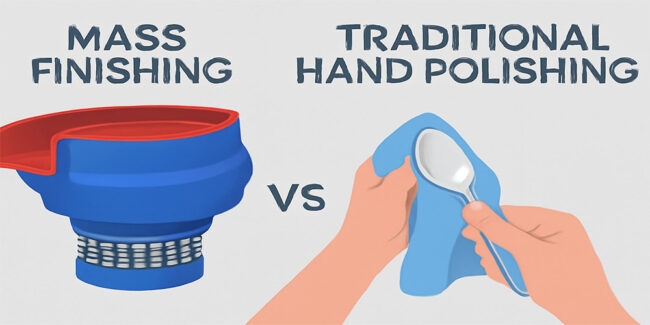
Image comparing mass finishing equipment with traditional hand polishing techniques, highlighting their differences.

Mass Finishing vs Traditional Hand Polishing Explained

Manufacturing professionals face a critical dilemma when selecting surface finishing methods: should they invest in automated mass finishing systems or rely on traditional hand polishing techniques? This decision impacts not only production costs but also final product quality, making it a pivotal choice that directly affects both operational efficiency and customer satisfaction. Mass finishing offers…

Understanding Different Burr Types and Removal Methods

Manufacturing engineers face a persistent challenge in metalworking: machining burrs. These unwanted material projections – whether rollover, tear, or thermal burrs – compromise part functionality, interfere with assembly, and increase safety hazards. Even with optimized machining parameters, complete burr prevention remains elusive, making effective identification and removal strategies essential for quality production. Understanding the distinct…

Choosing the Right Media Size: Mesh and Particle Comparison

Selecting the right media size for surface treatment can mean the difference between perfect parts and expensive rejects. Manufacturing engineers often face a frustrating disconnect between mesh numbers specified in technical documents and the actual particle dimensions needed to achieve desired finishes. This confusion leads to inconsistent results and wasted production time as teams struggle…

Essential Metal Additive Manufacturing Finishing Techniques

Metal additive manufacturing offers unprecedented design freedom, but raw 3D printed parts often fall short of production requirements. The layer-by-layer building process inherently creates surface irregularities, support structure attachment points, and internal stress concentrations that compromise both aesthetics and functional performance. Without proper finishing, even the most sophisticated AM parts can suffer from premature failure,…